Road Accident Injured to Get Timely Help
Government to Carry Out Digital Monitoring
Shivani Singh
New Delhi, Nov. 20.
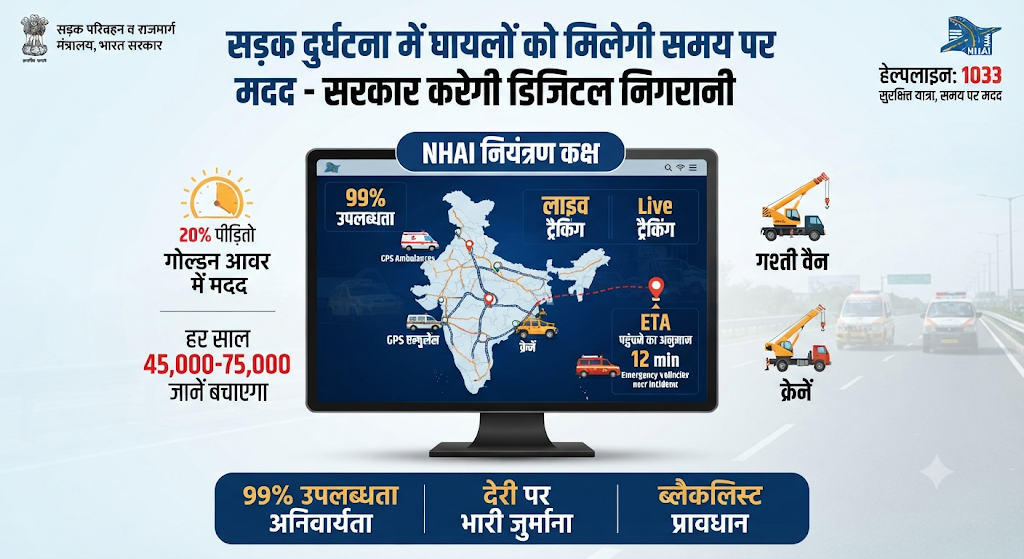
Failing to provide timely help to victims during the critical initial period after a road crash on national highways, known as the golden hour, has remained a major challenge for the country. According to a study, only 20 percent of accident victims currently manage to reach a hospital or trauma center within the golden hour. To bridge this wide gap and speed up emergency response, the Ministry of Road Transport and Highways issued a circular on November 18 deciding to put highway route patrolling and emergency services under live digital monitoring.
Under the new arrangement, the functioning of nearly 3,000 modern ambulances and route patrolling vehicles and around 1,000 cranes deployed across the country has been made directly accountable. Records of the presence and movement of these vehicles will no longer be kept in a traditional register, but through live digital tracking via the centralized NHAI Care Dashboard. AIS-140 standard GPS devices have been made mandatory on all emergency vehicles, enabling real-time monitoring from a control room in Delhi. This will immediately make clear which vehicle is deployed on which highway stretch and how long after receiving information it reached the spot.
Strict service level agreements (SLAs) have been set to enforce the obligation to reach the injured on time. If emergency vehicles or services fail to meet the 99 percent availability standard, heavy financial penalties will be imposed on the agencies concerned. Moreover, a per-minute fine will be levied for failing to reach the scene within the stipulated timeframe, and strict action such as blacklisting will also be taken for serious negligence. The government has also made it clear that deploying these emergency services will be mandatory before opening any new highway stretch to traffic.
Officials and experts believe that faster response and better coordination can bring a major improvement in the rate of getting injured patients to hospitals during the golden hour. Drawing inspiration from concepts such as Intelligent Transportation Systems (ITS) and Automatic Incident Detection (AID) in developed countries, coordination between traffic and medical units is being strengthened. The new system is estimated to save around 45,000 to 75,000 lives annually.