
Vande Bharat’s ‘sarathis’ in danger: More than 50 percent of loco drivers victims of severe mental stress and depression!
Shivani Singh
New Delhi, November 18
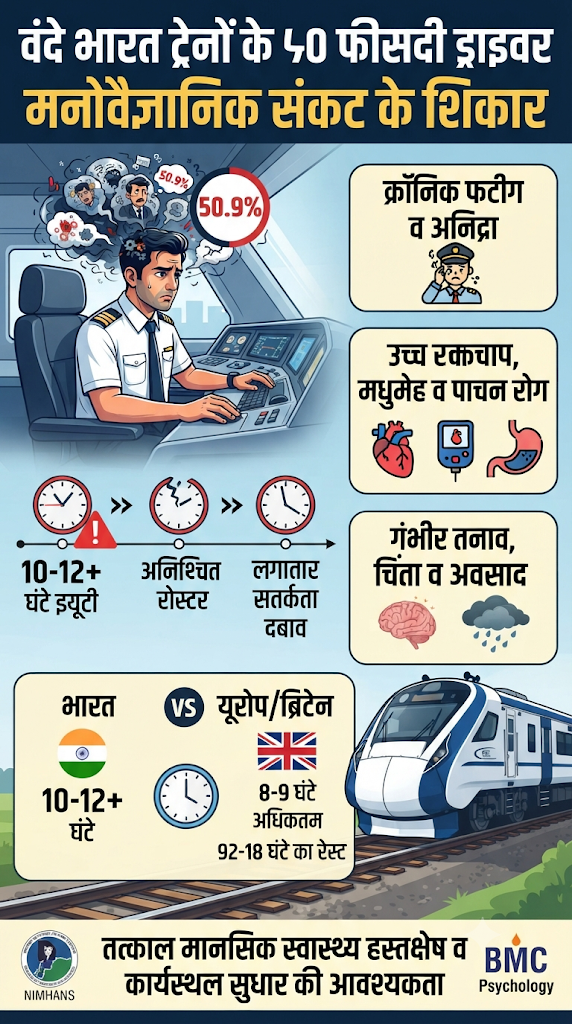
Loco drivers operating the country’s high-speed and modern trains are going through severe mental crisis today. A fresh research report published in NIMHANS, Bengaluru and the prestigious London journal ‘Biomedical Central Psychology’ has raised serious questions regarding Indian Railways’ safety and passenger security. According to this mixed-methods study, more than 50 percent of drivers of semi high-speed trains like Vande Bharat and Amrit Bharat are in the grip of severe mental fatigue and depression, posing a major threat to rail safety.
According to the study, the level of occupational stress and psychological distress among railway loco drivers in Bengaluru has reached an alarming level. Out of 287 loco drivers included in the survey, screening criteria for psychological distress were met by 50.9 percent of drivers, and clear symptoms of occupational stress were found in 34.2 percent. The duty hours of drivers are uncertain and exhausting. Spending 10 to 12 hours or more continuously in the cabin without any fixed rest has extremely fatal adverse effects on the human body and brain.
Under these severe adverse effects, due to excessively long working hours, the body’s sleep cycle (circadian rhythm) gets completely disrupted, leading to chronic fatigue and insomnia taking root. Apart from this, irregular eating habits and sitting in the same posture for long periods significantly increase the risk of digestive disorders, high blood pressure, and diabetes. On the mental level, due to cabin isolation and the pressure of remaining extremely alert every moment, symptoms of extreme mental stress, anxiety, and depression are rapidly dominating the pilots.
Comparing with international standards, while in India loco drivers have to work for 10 to 12 hours or more continuously with uncertain rosters, railway drivers’ working hours in the European Union and Britain are very strictly controlled. There, the maximum limit of a shift is generally not more than 8 to 9 hours, special rest and mandatory medical checkups are required upon doing night shifts, and a minimum rest period of 12 to 14 hours between two consecutive shifts is legally enforced.
On the other hand, under the rules prescribed by the railways (Section 132 of the Railways Act, 1989 and Railway Board guidelines), continuous duty of loco drivers is generally fixed between a maximum of 9 to 11 hours, but in ground reality, this duty often stretches further to 12 to 14 hours, which has a direct and deep impact on human health.
Researchers suggest that the existing wellness programs of the railways are proving to be on paper only; therefore, role-based mental health interventions specifically for loco drivers and immediate improvements in the workplace are extremely necessary to protect the health of drivers alongside passenger safety.