NETRA’ Saving Innocent Lives from Train Collisions
Indigenous 'NETRA' System Equipped with AI-Sensor Technology Developed
Shivani Singh
New Delhi, November 6.
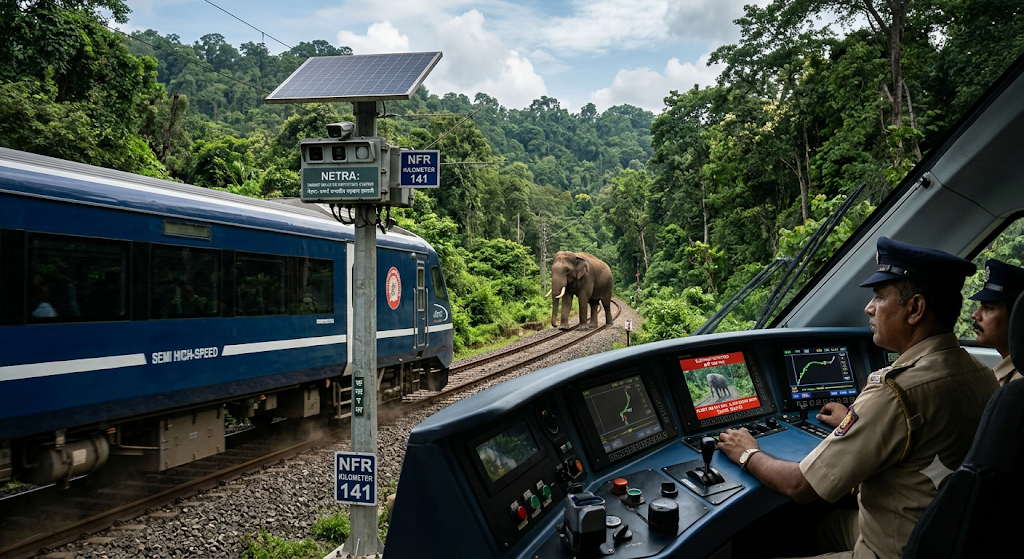
As the speed of semi-high-speed trains increases rapidly across the country, ensuring the safety of elephants, tigers, and other wildlife on railway tracks is becoming an increasingly significant challenge. To address this issue, researchers have developed an extremely cost-effective and indigenous prototype called ‘NETRA’, based on Artificial Intelligence (AI) and sensor technology. Operating without internet connectivity, this technology is fully capable of instantly detecting the presence of any animal or obstruction on the tracks and alerting the locomotive pilot in a timely manner. Following a green light from the Railway Board, plans are underway to implement this technology in sensitive corridors.
According to railway officials, NETRA (Smart Railway Obstruction Detection System) relies on IoT, computer vision, and internet-free LoRa communication. It automatically identifies humans, large animals, and any kind of obstruction near the tracks and sends warnings to the locomotive pilot. During its testing phase, it yielded a 95 percent accuracy rate. Throughout the trials, it successfully identified 42 human intrusions, 15 animal intrusions (including cows and horses), 8 elephant crossings, and 12 track obstructions.
Technically, the system activates its main camera only after confirming movement through PIR motion and ultrasonic sensors. Subsequently, the Edge-AI model locally analyzes the image and, once a threat is confirmed, transmits a warning message to the locomotive pilot within a mere 2.4 seconds.
Nationwide Expansion Plans and Cost Efficiency
The system is currently operational on 141 route kilometers of the Northeast Frontier Railway (NFR), covering the most sensitive elephant corridors identified by the Forest Department. Additionally, tenders have been awarded for its expansion across a 981 route-kilometer radius nationwide. The government plans to implement NETRA in two phases between 2026 and 2028. Trials of thermal vision cameras are also underway for accurate wildlife identification during nighttime.
The greatest advantage of NETRA is its cost-effectiveness. Its installation cost is estimated at approximately $247 USD per kilometer, which is roughly 75 percent lower than traditional DAS-based systems.
Frightening Statistics of Accidents
According to data from the Ministry of Environment, a total of 79 elephants lost their lives due to train collisions across the country over a five-year period (2020-21 to 2024-25). Looking at state-wise figures, elephant deaths during this period included 25 in Assam alone, 18 in Odisha, 13 in Uttarakhand, 5 in Jharkhand, 4 in Kerala, and 4 in Tamil Nadu. In this scenario, a technology like ‘NETRA’ can prove to be a major milestone in saving the lives of these voiceless animals.