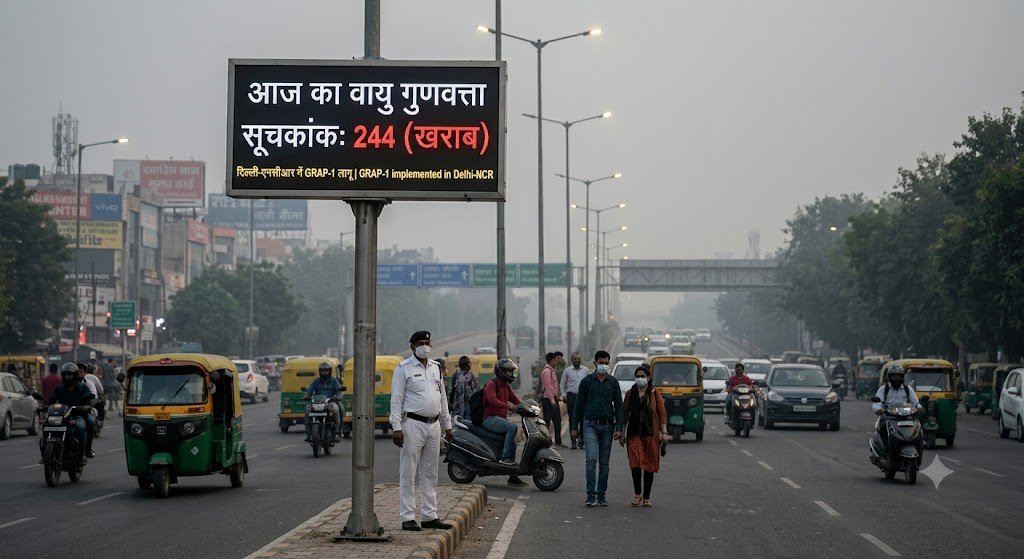
Rising pollution worsens Delhi-NCR air quality, GRAP-1 implemented across NCR
air quality index in Delhi
Shivani Singh
New Delhi, October 21.
Amid the onset of winter and the festive season, following a sharp decline in the air quality index (AQI) in Delhi-NCR, the Centre’s Commission for Air Quality Management (CAQM) has immediately implemented the first phase of the Graded Response Action Plan (GRAP) across the entire National Capital Region. This decision comes in the wake of a sudden deterioration in wind patterns over the past 24 hours.
AQI surges by 65 points in 24 hours, crosses the 244 mark:
According to official data from the Central Pollution Control Board (CPCB), a massive spike in pollution levels was recorded in Delhi within a single day. While the capital’s average Air Quality Index (AQI) stood at 179 on October 20 (categorized as ‘moderate’), it surged by 65 points to cross 244 by 2:00 PM on October 21. As the AQI entered the ‘poor’ category between 201 and 300, an emergency meeting was convened, and orders were issued to enforce GRAP-1 restrictions across the NCR.
According to forecasts by the India Meteorological Department (IMD) and the Indian Institute of Tropical Meteorology (IITM), air quality is expected to remain in the ‘poor’ category in the coming days due to slow wind speeds and falling temperatures.
—
Key Guidelines and Restrictions under GRAP-1 :
Strict monitoring of construction and demolition activities:
Compliance with environmental norms has been made mandatory at all construction and demolition (C&D) sites spanning over 500 square meters. Transporting or storing construction materials without proper covering is strictly prohibited. The use of anti-smog guns and water sprinkling has been stepped up for dust control.
Ban on coal and wood-fired tandoors in hotels and eateries:
The use of coal, wood, and biomass has been completely banned at hotels, restaurants, and roadside food stalls. Only LPG and electric appliances are permitted as alternatives.
Crackdown on vehicular emissions:
Instructions have been issued to conduct special drives for checking Pollution Under Control (PUC) certificates, along with speeding up the impounding and challan process for 10-year-old diesel and 15-year-old petrol vehicles. Additional traffic police personnel will be deployed at major intersections to tackle traffic congestion.
Zero tolerance for burning garbage and biomass:
Burning garbage, dry waste, plastic, or leaves in open spaces remains strictly prohibited. All municipal bodies have been directed to heavily penalize violators.
Mechanical sweeping and water sprinkling:
The deployment of anti-smog guns, water sprinklers, and mechanical sweeping machines has been increased on roadsides to curb road dust.
—
Appeal to Citizens
Releasing a ‘Citizen Charter’, the Commission has appealed to the general public to make maximum use of public transport (buses and metro), maintain proper tire pressure in vehicles, turn off engines at red lights, and wear masks to protect against dust.
The administration has clarified that if air quality does not improve and the AQI crosses 300, the situation will be reviewed to implement stricter measures (GRAP Stage-2).