

Shivani Singh
New Delhi, October 8.
To eliminate long queues and traffic congestion at toll plazas on national highways, the Ministry of Road Transport and Highways is set to bring a major policy shift. Instead of waiting for vehicular bottlenecks or accident-prone situations to build up, the ministry will leverage FASTag and digital vehicle databases to upgrade highway infrastructure well in advance. Under this new strategy, preparations for highway widening or constructing bypasses will commence two to three years before traffic volume exceeds a highway’s actual capacity.
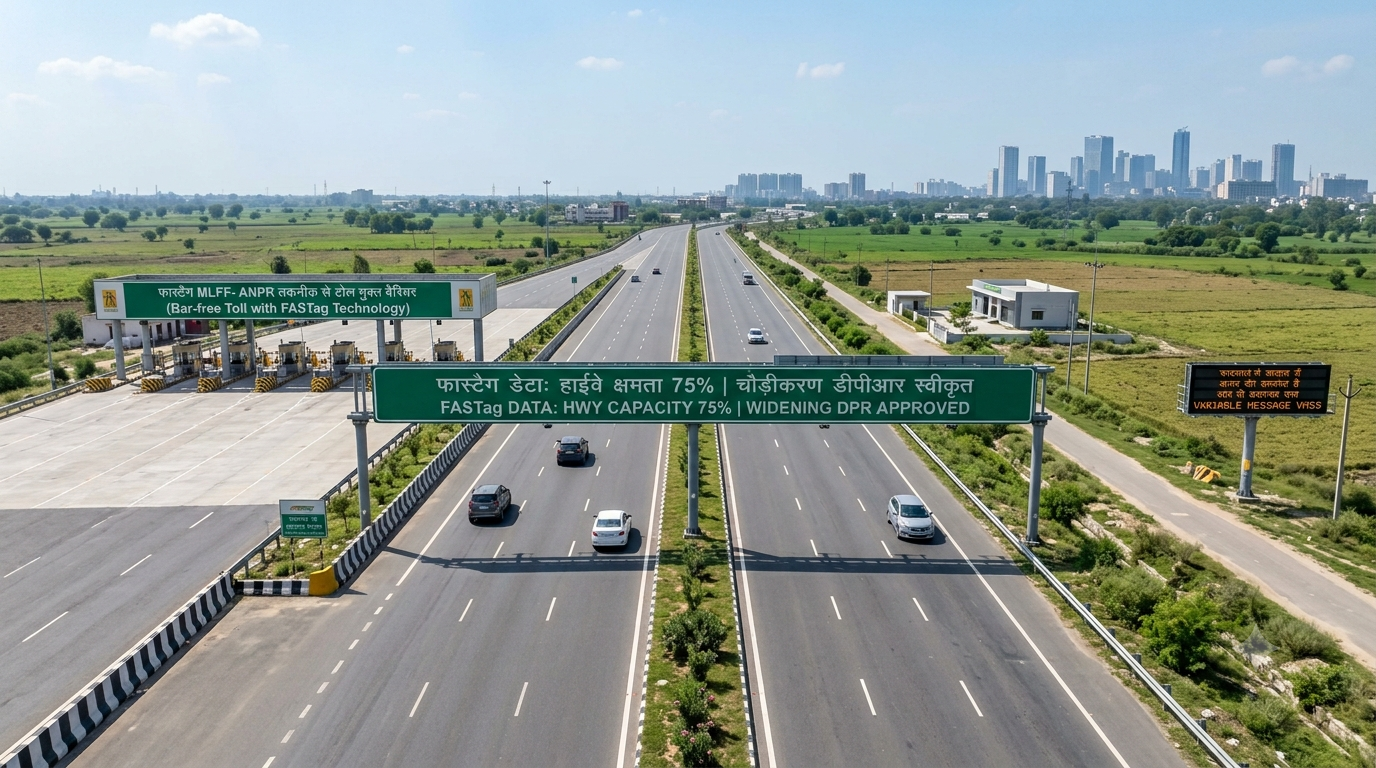
According to sources in the Ministry of Road Transport and Highways, FASTag’s role will no longer be limited to toll collection alone. Its data will now be analyzed to understand traffic movement patterns, average speeds, and overall infrastructure needs. As soon as traffic volume on any highway stretch approaches 75 to 80 percent of its maximum capacity—measured in Passenger Car Units (PCU)—the digital system will automatically issue an alert. Upon receiving this alert, the process of preparing a Detailed Project Report (DPR) and acquiring land will begin immediately, ensuring the road can be timely expanded to four, six, or eight lanes.
——–
Relief from Festive and Holiday Traffic Jams
Traffic surges and long queues at toll plazas are common during weekends, holidays, and major festivals. To manage this, an Artificial Intelligence (AI)-driven traffic control system is being developed. By analyzing FASTag trends, the system will identify potential bottleneck plazas in advance. Drivers will then receive real-time alerts about alternative routes and diversions 20 to 30 kilometers ahead through the ‘Rajmargyatra’ mobile app, Google Maps, and dynamic Variable Message Signs (VMS) installed along highways.
—————–
All Toll Plazas to Become Completely Barrier-Free by March 2027
To maintain seamless vehicular speeds at toll plazas, work on Multi-Lane Free Flow (MLFF) and Automatic Number Plate Recognition (ANPR) technologies is progressing rapidly. This barrier-free mechanism will allow vehicles to cross toll zones at speeds of 60 to 80 km/h without stopping. The Ministry and the National Highways Authority of India (NHAI) have decided that 70 percent of major toll plazas across the country will be converted into barrier-free corridors by December 2026, with the entire national highway network transitioning by March 2027. Additionally, data from heavy commercial vehicles will be utilized to schedule timely maintenance and repairs of highway stretches.
————