
Shivani Singh
New Delhi, October 4.
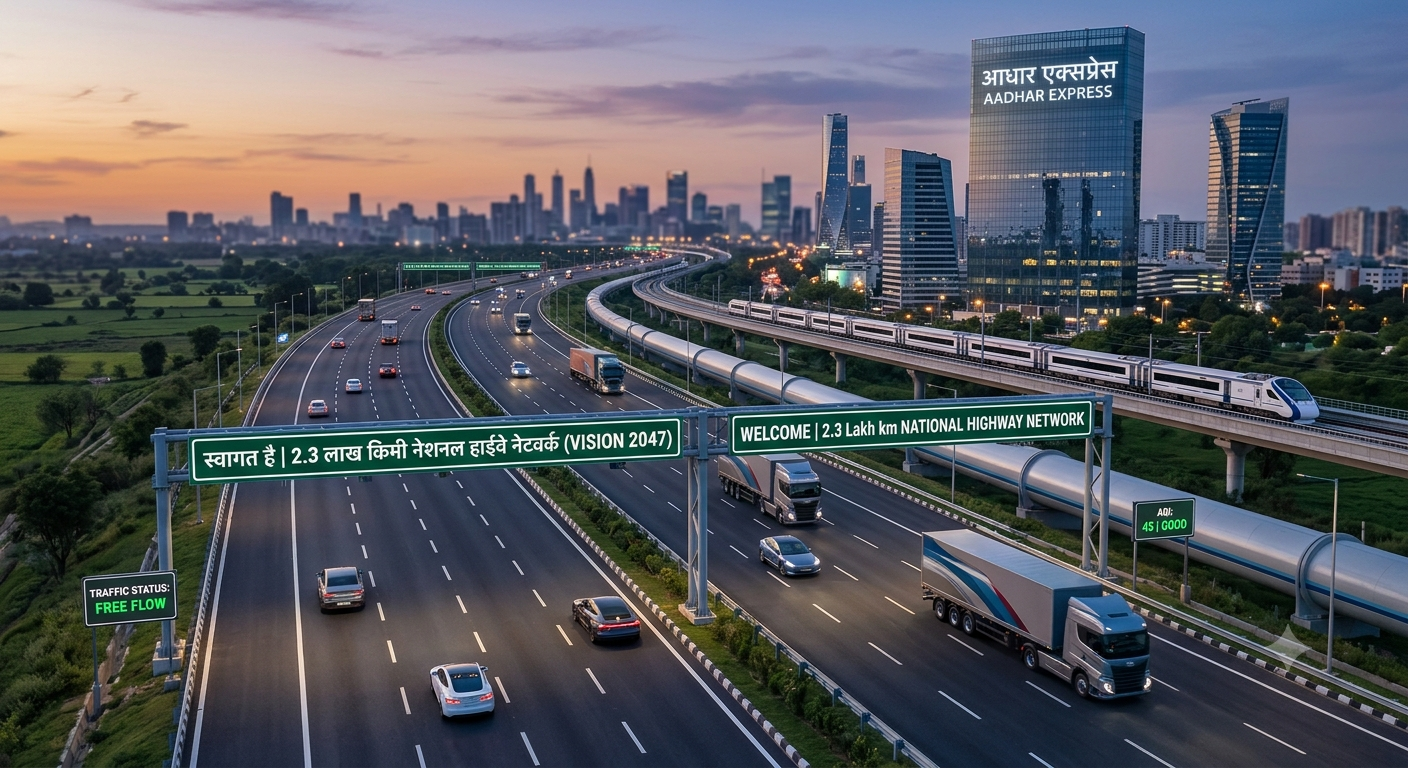
In line with the national goal of transforming India into a developed economy by 2047, the Central Government has drawn up a comprehensive plan to revamp the country’s infrastructure. Under a joint roadmap prepared by the Ministry of Road Transport and Highways and NITI Aayog, a 2.3 lakh kilometer modern national highway network will be constructed across the nation. The ambitious project involves building access-controlled highways and new expressways, which will reduce travel time between major cities by 30 to 40 percent.
The policy draft was approved during a high-level meeting of top officials from the Ministry of Road Transport, NITI Aayog, NHAI, and NHIDCL. According to officials, this massive infrastructure push will give fresh momentum to economic growth while generating large-scale employment opportunities. New industrial corridors, logistics parks, and agro-processing zones will be developed along this 2.3 lakh kilometer network, creating significant livelihoods in Tier-2 and Tier-3 towns both during and after construction. To cut travel times, advanced technologies such as new route alignments, GNSS-based satellite tolling, and intelligent traffic management systems will be implemented.
A joint study by the Central Road Research Institute (CRRI) and NHAI estimates that artificial intelligence (AI)-enabled sensors, Intelligent Traffic Management Systems (ITMS), and modern road safety standards could reduce road accidents by 20 to 25 percent. Additionally, to strengthen the supply chain, key ports, airports, and agricultural markets (mandis) will be directly connected via 4- and 6-lane expressways, ensuring farm produce reaches markets swiftly and without disruption.
—
‘Urban De-congestion Policy’ to Relieve Metros of Traffic and Pollution
Under the new master plan, an ‘Urban De-congestion Policy’ will be implemented to free major metros like Delhi, Mumbai, Kolkata, and Chennai from traffic congestion. The strategy focuses on restricting inter-state heavy commercial vehicles and diesel trucks at city borders. For this, Multi-Modal Logistics Parks (MMLPs) and congestion-free zones will be built on the outskirts. Heavy vehicles passing through will be routed via ring roads, bypasses, and elevated corridors, while freight unloading will take place outside city limits. Keeping heavy vehicles out of cities is also expected to significantly drive down urban air pollution levels.
——————